17th Aug 2026
It is the figment of your imagination. That India is only populated by Hindus. Let’s set the table right. For centuries now India has been a cross-cultural melting point and its little wonder that is woven into its complex, but incredibly rich tapestry is its religious pluralism. While 83 percent of its populace is Hindu, the country is also home to Muslims, Sikhs, Christians, Buddhists, Parsees, Jews, Bahais and many other communities, who continue to follow diverse religious faiths and practices. If anything, India has long been regarded for embracing this cultural diversity on which it pivots its constitutional largesse, which guarantees freedom of religion as a fundamental right.
Let's take our cinematic lens and put the spotlight on a few amazing religious structures…those beautiful gems which illustrate how India’s religious pluralism shapes its architectural dreams. These touchstones of devotion, which define its sacred landscape, remain a compelling vision of boundless faith divine, inspiration and creative prowess. These extraordinary architectural expressions are a shining reflection of a legacy of spiritual rootedness that reminds us that for India, its social and sacred landscape are inextricably intertwined— creating that unique paradox of ‘unity in diversity’.
That deathless trinity of Hindu religious architecture...the Nagara (North India), the Dravidian (South India) and the Vesara (Deccan Region— a hybrid version comprising components drawn from both Nagara and Dravidian traditions) styles are beautifully represented by the plethora of temples spread across different geographies in the country. But even amongst these there are those which stand out for their sheer splendour and magnitude of the artisan’s visionary mindset. Scale is no bar; and their flights of fantasy defy even the biggest challenges of brick and mortar.
The Meenakshi Amman Temple, Madurai
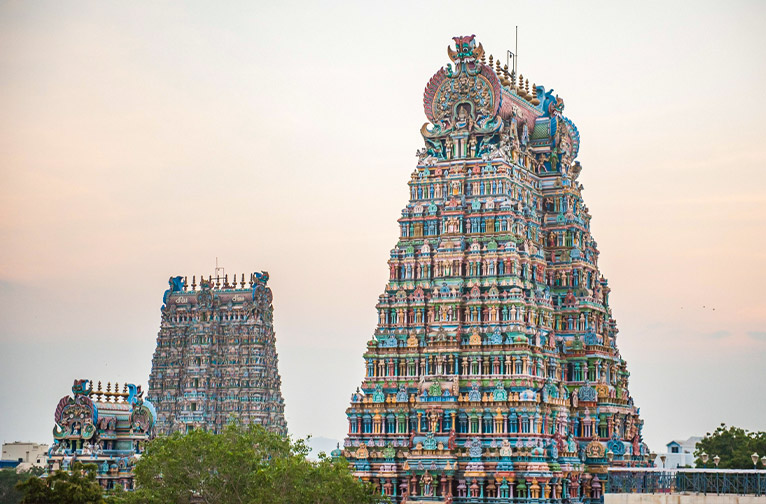
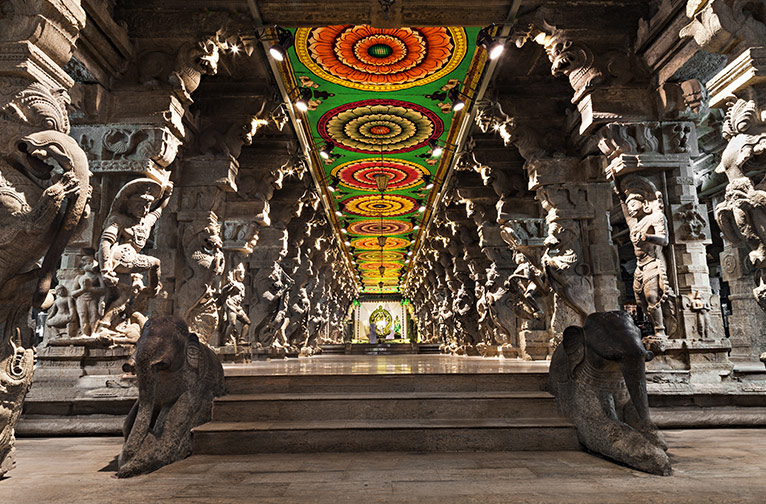
It is the very heart of the ancient city of Madurai. Steeped in myths and spirituality, the Meenakshi Amman Temple in the southern state of Tamil Nadu is said to date back to over 2500 years. The 14 great towers (gopurams) of this iconic temple are a fabulous homage to the artisanal wealth of southern temple traditions. Its tallest tower stands at a dizzying height of 170 ft, no less. Depicted in a glorious burst of spiritual endeavour the craftsmen have let loose their imagination, devotion and skills to ornament every single space with thousands of colourful carved images of deities and demons, and animals too, in all the shades of the rainbow. The Hall of 1000 Pillars is another iconic attraction of the site. It is a marvel of engineering and acoustics—when tapped, certain pillars produce musical notes corresponding to traditional Carnatic ragas.
Meenakshi Amman Temple, also known as Meenakshi Sundareswarar Temple, reflects the visionary splendour of the Dravidian-style architecture in all its unalloyed glory. The fabulous complex showcases an expansive array of over 33,000 intricate sculptures, the carved pillars of the mandapams, assembly halls and shrines. Its exotic design is reflective of its moorings in a rich cultural heritage and a deep understanding of geometry, symbolism, and craftsmanship which harks back to the 6th century BCE.
Konark Sun Temple, Odisha
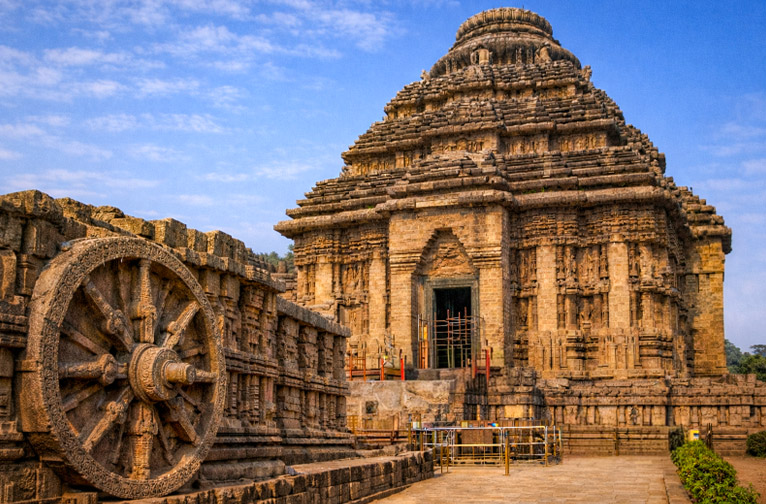
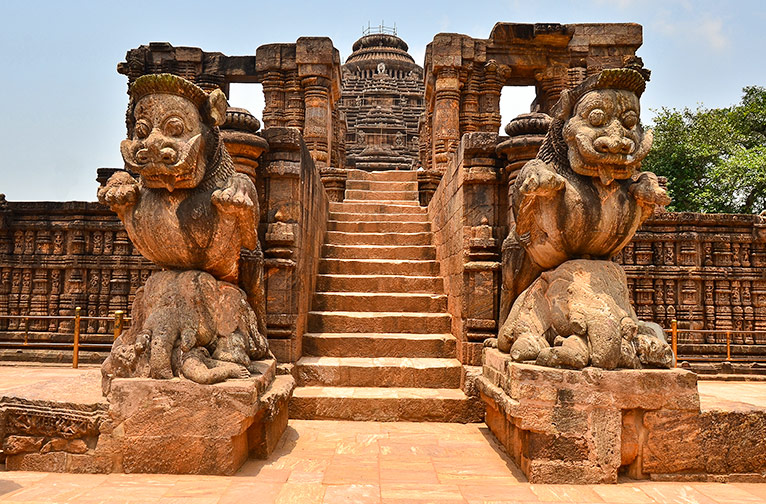
Raised to the Hindu god Surya, or the Sun God, the 13th century temple has been conceived as a massive chariot set upon 24 wheels, drawn by seven horses. Carved out of black granite and red sandstone, and also known as the Black Pagoda back in the day, it was a beacon for vessels sailing the waters of the Bay of Bengal from the Indies. The temple is so positioned as to catch the rays of the rising sun and bathe it in eternal glory with that illumination. Built on Konark Beach the Konarak Temple is a fabulous vision of architectural accomplishment and engineering skills of the ancient world. The temple which “marks the apogee of the wave of foundations dedicated to the Sun God Surya” is an “outstanding testimony to the 13th-century kingdom of Orissa. It is directly and materially linked to Brahmin beliefs and forms the invaluable link in the history of the diffusion of the cult of Surya, which originated in Kashmir during the 8th century and finally reached the shores of eastern India”.
Though largely in ruins today, from what remains you cannot miss the grand vision behind its monumental execution. Keep your eyes peeled on the façade of the plinth of the temple and marvel at the dense carvings of human figures, floral, animal and geometric motifs which cover every inch of space.
The Basilica of Bom Jesus, Goa
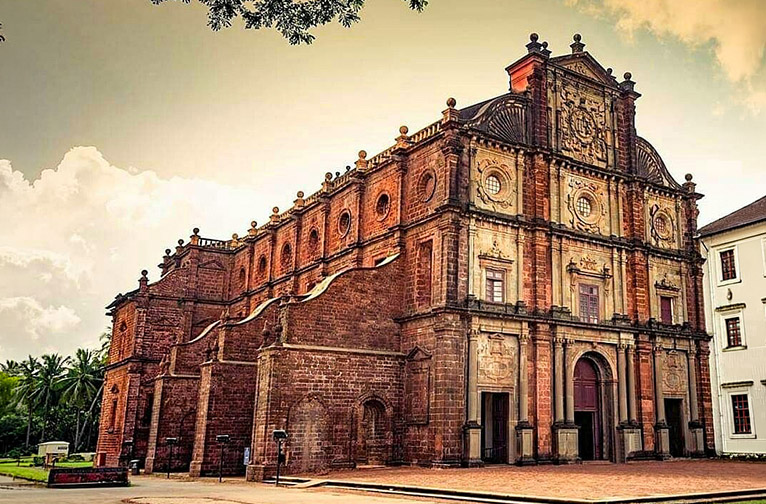
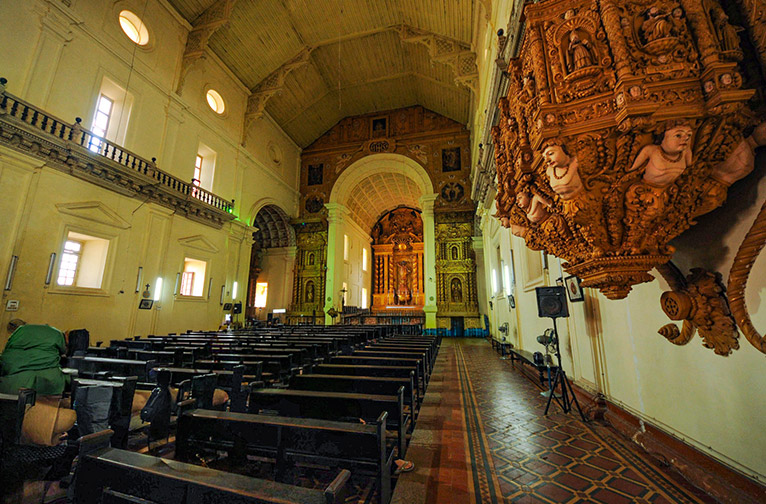
One of the most visited tourist attractions, the Basilica in Old Goa draws people of all faiths to marvel at an exemplar of stunning baroque architecture in India. Dating back to 1605, the church offers a superb window to the peak of Portuguese architectural achievement in India as much as it represents Goa's rich Christian heritage You are first introduced to its glorious antecedents by the Corinthian, Ionic and Doric elements and intricate bas-reliefs which welcome you to its deceptively simple, unplastered red laterite stone, entrance. Your footsteps lead you into a contrasting world of artisanal glory as you look upon the sumptuous fusion of golden altars and rich marble inlay in its beguiling interiors. Check out the canopied, intricately carved wooden pulpit. Your gaze is compelled to move to the striking main altar, dedicated to the Infant Jesus, with its stunning gold-plated carvings. The adjoining mausoleum, a masterly representation of Jesuit art, is the repository of the mortal remains of St. Francis Xavier in a silver casket. Unmissable here are gilded twisted columns and wood floral decorations. The complex includes two chapels, a main altar, and a sacristy. The Basilica has won the acclaim of UNESCO World Heritage Site for its superb symmetry, the expansive nave and the grand dome, beautifully complimented by the intricate woodwork, and lavish use of gemstones.
Matrimandir Meditation Center
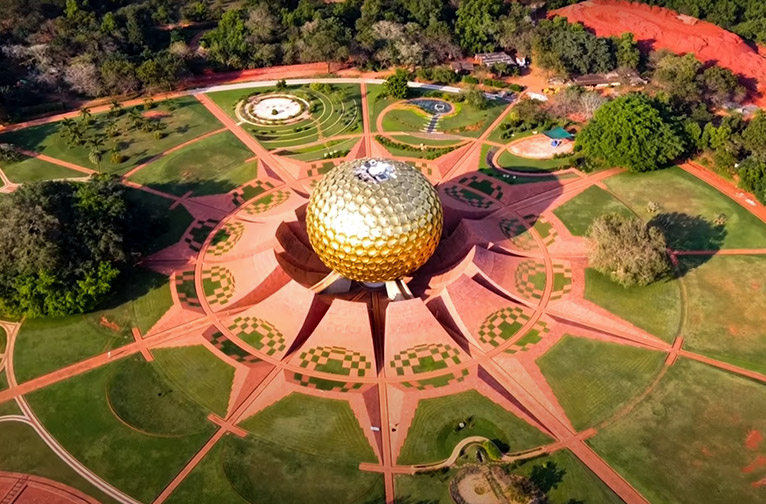
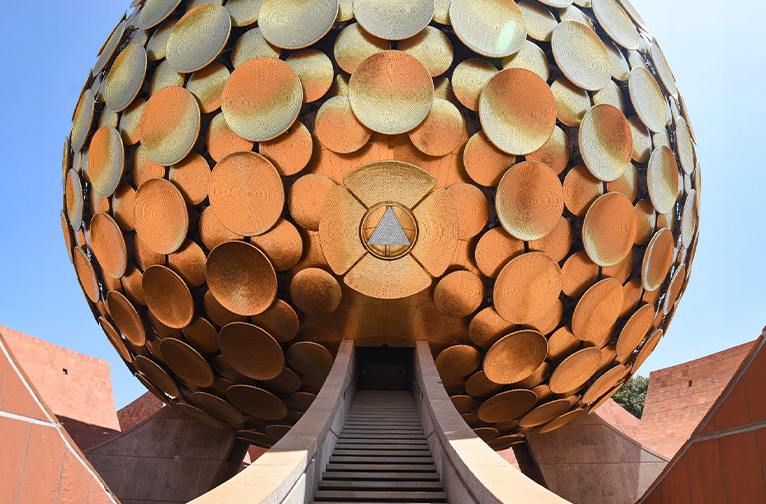
A visit to Pondicherry (Puducherry) would be incomplete if you don’t take time out to explore Auroville, its spiritual and cultural hub—inextricably linked to the spiritual teachings of Sri Aurobindo and his French-born spiritual partner, Mirra Alfassa, also referred to by the community as The Mother.
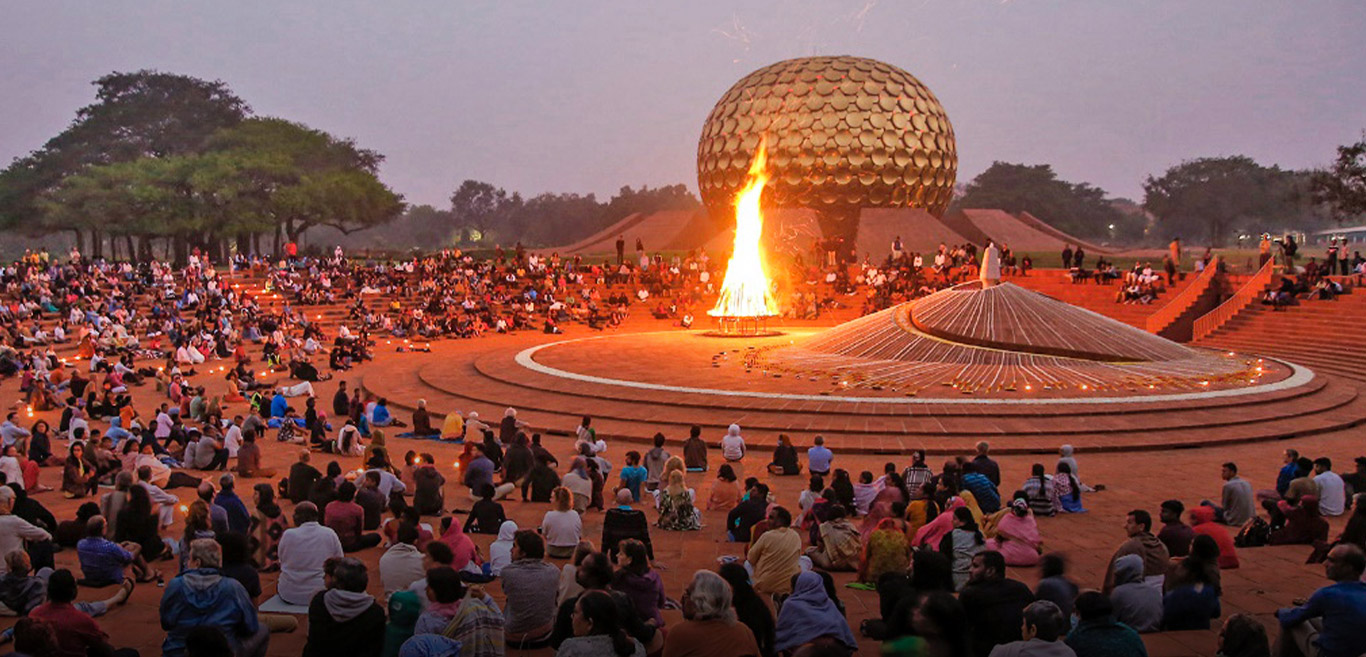
At the core of this community-based settlement lies the Matrimandir Meditation Center, set in the Park of Unity. A golden globe tethered to the earth is the most distinctive architectural element of the Matrimandir. It represents the birth of a new spiritual consciousness. The gilded visual which greets the gaze takes voice from an ornamental cladding of stainless-steel discs airbrushed with gold foil. A circular pathway girdles the Matrimandir and the Petals. To enter the Matrimandir one has to go down one of these four wide pathways between two large Petals. Eight Pathways lead steeply down between the Petals to the Lotus Pond below. At the bottom one has to remove one’s shoes and climb the wide granite staircase rising between the Pillars to the doors above.
All is cool and white inside, a sensory vibe heightened by the extensive use of pristine white marble. The centerpiece of the meditation chamber is an artificial crystal 27.5 inches (70 cm) in diameter; it’s believed to be the largest optically perfect glass in the world. It rests on a 35 cm cube-shaped stand consisting of 4 upright gilded Sri Aurobindo symbols which support each other by the points of their triangles. The only source of light in the chamber comes from the sun’s rays kissing the crystal via a programmed heliostat set upon the roof of the complex. The Inner Chamber is a place meant for concentration, to learn how to concentrate to find one’s consciousness. A partially shaded walk of about 10 minutes leads from the Visitors Centre directly to the Viewing Point.
Rumtek Dharma Chakra Centre, Sikkim
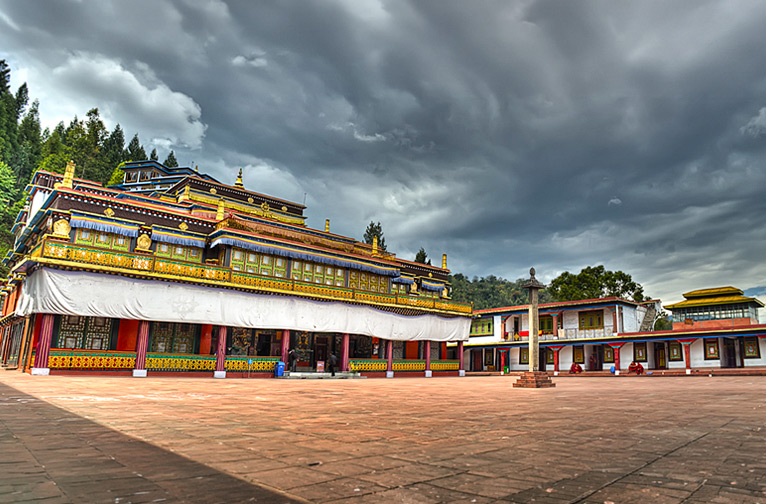
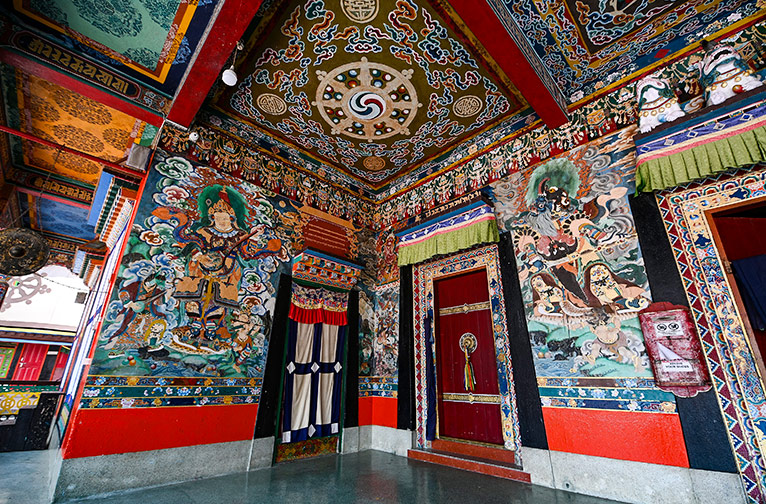
Just a short drive away from Sikkim’s capital city located on a hill in the town of Gangtok, lies the state’s largest monastery. Within the complex of the Rumtek Monastery lies the Rumtek Dharma Chakra Centre which promotes the teachings of the buddha of love and peace amongst men. Dating originally to the 17th century, from the ministrations of the 12th Karmapa Lama Changchub Dorje, Rumtek belongs to the Karma-Kagyu order of Tibetan Buddhism. The structure of the complex underwent a massive overhaul under the auspices of the 16th Karmapa Rangjung Rigpe Dorje, who had fled from Tibet during the Chinese invasion in 1959, and the royal family of Sikkim.
This sacred space is set along the lines of Vajrayana Buddhist architecture—a mandala – representing the spiritual map of the cosmos. It offers a superb window to indigenous Tibetan artisanal skills. It is a stunning replica of Tibet’s stunning Tsurphu Monastery in Lhasa with its vibrant colours of red, blue, yellow and green, all deeply symbolic. Don’t miss the extensive, intricately rendered woodwork! The cynosure of all eyes in the 3-storied complex is the Tsurfu Labrang, the primary structure, which is awash with a mass of hand painted murals and stunning frescoes centred around the deities and mandalas of Tibetan Buddhism. Repeated images across the complex in different formats are the Dharma Wheel, the Lotus, and the Endless Knot.
The large red pillared prayer hall, or Tsulakhang, on the ground floor, features four life-size images of the guardian kings of the universe facing the four cardinal directions. Inside are superb intricate wall murals, thangkas, silk paintings and statues. The cavalcade of buildings includes assembly halls, libraries, and monks’ residential quarters. The massive Golden Stupa, with its adornments of gems, rich carvings and circumambulatory path is the pivot point of devotion. It contains the mortal remains of the 16th Karmapa Rangjung Rigpe Dorje. It also has an amazing collection of Buddhist scriptures, and thangkas. Rumtek became the most important repository of, not on the holy objects and relics carried away by His Holiness from Tsurphu Monastery, but also the mission of scholarship and spiritual attainment and practices of the Buddhist faith.
A journey across India opens up a veritable treasure trove of religious structures which compel visitors to delve deeper into its spiritual and artisanal landscape, and the borderless visionary splendour of its perspective of life in all its richness.