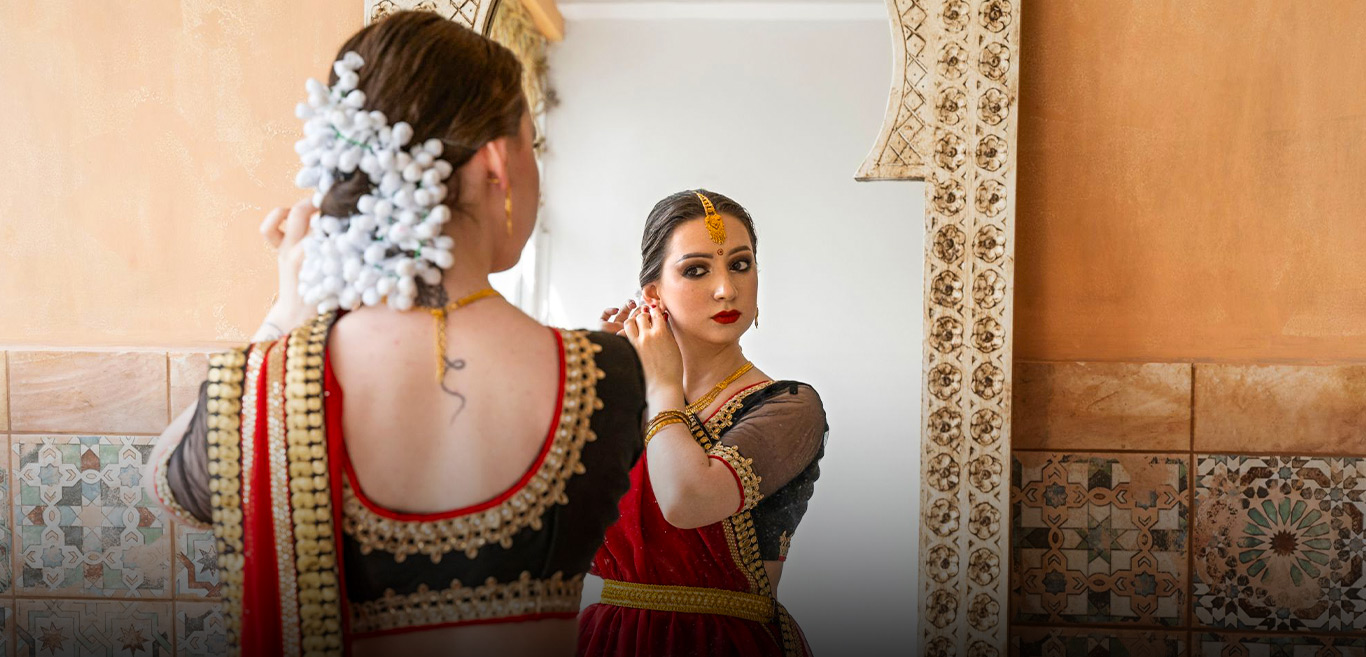
Solah Shringar— Ancient India’s Ode to A Woman’s Beauty
7th Nov 2025

Solah Shringar— Ancient India’s Ode to A Woman’s Beauty

It’s interesting to note that for ages women have made huge efforts to beautify themselves— for their own vanity and for the world. Could it come from the fact they have always felt they were an afterthought when Tvashtr the divine architect and craftsman for the creation of all creature earth, having used up all the solid material at hand to create man had nothing left over to create woman. 


After deep thought, he decided to fashion her out of the ephemeral elements— So he took the roundness of the moon, the winsome curves of creepers, the clinging of tendrils, the trembling of grass, the slenderness of the reed, the bloom of flowers, the lightness of leaves, the tapering of the elephant’s trunk, the glances of deer, the joyous gaiety of sunbeams, the weeping of clouds, and the fickleness of the winds, the timidity of the hare, the vanity of the peacock, the softness of the parrot’s bosom, the hardness of adamant, the cruelty of the tiger, the hot glow of fire, the coldness of snow, the chattering of jays, the cooing of the dove, the hypocrisy of the crane, and the fidelity of the drake.

And thus did Tvashtr, the primordial artisan of all living creatures, create women.

From your travels across India, from the Khajuraho Temples to Konark Sun Temple, the Rani ki Vav stepwell to the Hoysala temples at Belur and Halebid or Ajanta & Ellora and many more, you are bound to come away with some incredible memories of the painted or sculpted beauties carved into its most iconic monuments, temples, rock shelters, stepwells, etc. Prominent amongst the exquisite sculptures are images of celestial damsels including Surasundaris, Salabhanjikas and Madanikas, and earth spirits like Yakshis. You would’ve seen women in various poses or pursuing a range of activities including adorning themselves in jewels and attire. Well documented images include Lady with a Mirror applying kajal (kohl) or sindoor (vermilion) in her hair parting; adorning her hair with a flower, adjusting her anklet; rinsing water from wet braids; painting henna on the feet, applying a bindi on the forehead, elaborately dressed in jewellery from head-to-toe etc.


The resplendent antiquity of India is a layered treasure, which has blown away kings, conquerors and commoners from home and aboard for centuries on end. An enticing chapter that’s worthy of our particular attention is India’s fantastic art of adornment of the female form. From the makeup to the attire, to the jewel which glitter on a woman’s body from head to toe, it is an awesome mapping of the allure of a winsome lady for not only the male gaze, but also the mirrored image of her which panders to her personal vanity.

There’s a lovely little tale which has emerged from our ancient repository of myth and folklore related to Rati, an uncommonly beauteous woman, and Kama, the god of love. To win the heart of Kama, Rati endured a long and austere penance for the Goddess Lakshmi. Moved by her dedication Lakshimi bestowed upon her the secret of Solah Shringhar, 16 divine adornments, which in her avatar as Parvati she herself had used to win Lord Shiva. The Solha Shringar tradition is the physical and spiritual embodiment of a woman’s shakti or energy.

The deities play a pivotal role in every aspect of life! And so, the grateful Rati gathered around her friends and set out to adorn herself with the celestial armour of physical adornments to bewitch Kama—who in the end was truly smitten and married her.

The 16 sacred adornments— mehendi; bindi; sindhoor; maang tikka; kajal; nath; earrings; bangles; necklace; bajuband; arsi; kamarband; payal; bichua ; ittar, attire— protect a bride from any planetary imbalances and awaken her divine energy. 


The night before the bride and her family and friends adorn their hands and feet with Mehendi (henna) as an auspicious sign for the forthcoming ceremonies. The rituals next day begin with the Divine Bath, with a scrub of oil, milk, turmeric powder, sandalwood powder, and gram flour— leaving her skin smooth, fragrant and radiant. The hair is oiled and washed off with a combination of herbs. This is followed by Keshapasharachana when the hair is dried with incense and tied up in a bun or braids, adorned with flowers or jewels. Kajal made with ghee or camphor brightens and beautifies the size and shape of the eye; Bindi is a shield for the anjana chakra, or third eye (a powerful energy centre) located at the centre of the forehead between the eyebrows. Jewellery includes Maang Tikka a hair accessory that adorns the forehead of the bride; Nath A symbol of marital status, it pierces the nose at a point which is linked to the reproductive organs of a woman; Karn Phool or earrings are associated with Karn or Kama the god of love; Necklace regularizes the blood circulation and controls the blood pressure. The Mangal Sutra made of black and gold beads, is a symbol of love and the longevity of the husband; Bajuband worn on the bride’s upper arms symbolises wealth, wards off the evil eye; Bangles signify prosperity, good fortune and the wellbeing of the husband. Hathphool and Aarsi Ring enhance the beauty of the bride’s hands. The ring allows the bride to secretly look at her groom from behind her veil; Suhag ka joda, the bridal attire; Kamarband worn at the waist helps keep the sari in place. Is believed to help protect the reproductive organs; Payal an incarnation of goddess Lakshmi; Bichhiya The toe ring is usually worn on the second finger of the feet, whose blood vessels are connected to the uterus and heart. Maintains menstrual cycles, supports fertility, and lowers the risk of miscarriage; Itar keeps her fresh and fragrant on her special day; Sindhoor applied on the parting of the hair of the bride by the groom on the day of the wedding.

Solah Shringar serves as the idyllic fusion of myth, spirituality, science, Ayurvedic wisdom — and the blessings of the deities for the Hindu bride on her special day.